
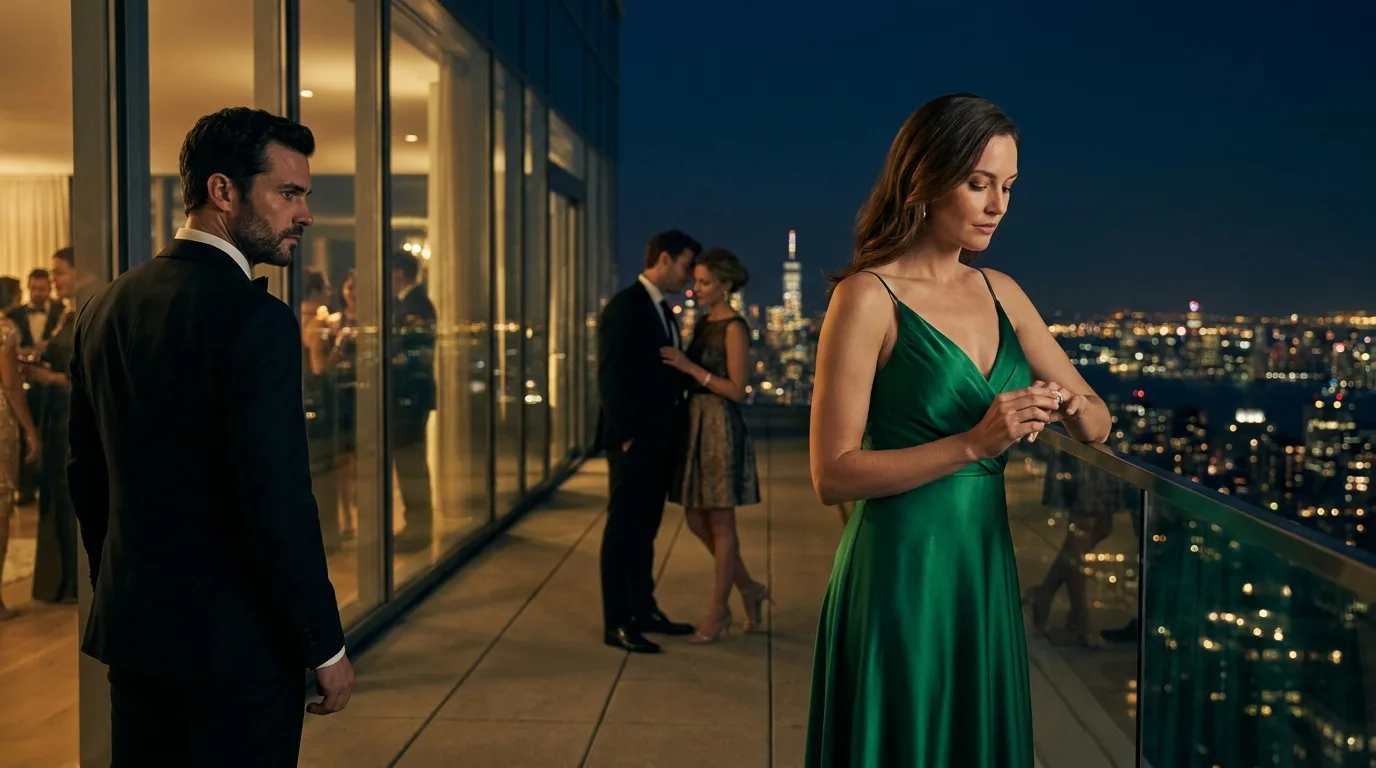
There is a particular kind of silence a woman learns to wear like a second dress.
I wore mine that night in ivory silk, standing at the edge of my own anniversary gala, watching four hundred people drink my husband's champagne and toast a fortune I had built with my own two hands.
Not that any of them knew that.
They knew me as Mrs. Rhys Ashford. The pretty one. The quiet one. The wife who smiled in the background of the magazine spreads while Rhys explained, in that low honeyed baritone, how he had cracked the markets with nothing but instinct and nerve.
Instinct. Nerve.
Try nine hundred lines of code and a pricing model I dreamed up at three in the morning over a bowl of cold noodles, six years ago, when the fund was two desks and a prayer.
But tonight was different. Tonight, Rhys had promised, was mine.
“The board's ready,” he'd murmured that morning, straightening his cufflinks in the mirror behind me. “After tonight, everyone will know exactly what you've done for this firm, Evie.”
I'd believed him. God help me, after five years, I still believed him.
So I stood near the ice sculpture — a rearing stallion, because subtlety was never a family value — and I waited to be named. To be seen. To finally step out of the frame and into the picture.
A waiter drifted past with a tray. I took a flute I didn't intend to drink.
Across the ballroom, Rhys was laughing with a cluster of investors, his hand resting at the small of a woman's back.
My cousin's back.
Bianca looked luminous in scarlet, twenty-four and hungry in the way I used to be before the world sanded it out of me. She'd come to us two years ago, fresh out of business school, and I'd handed her a job because family is family and my aunt had begged.
I'd taught her the desk myself. Which trades to watch. How Rhys liked his briefings. How to survive him.
I should have taught her less.
That's the thing nobody tells you about being overlooked. You get very, very good at watching.
I'd spent five years reading rooms because no one bothered to read me. It had made me the most dangerous kind of invisible.
The kind that sees everything.
I saw the way the caterers had run short on the good champagne and switched to the cheaper label at the back tables. I saw which investor was quietly bleeding money and which two were about to. And I saw my husband work the room like a con man who'd started to believe his own pitch.
He was beautiful, Rhys. I'll give the devil that. Silver at the temples, a jaw made for magazine covers, a voice that could talk a widow out of her pension and make her thank him.
When I met him at twenty-three I'd thought I'd won something.
It took me years to understand I'd been acquired, filed, and shelved.
“Ladies and gentlemen.” Rhys tapped a knife to crystal, and the room turned to him like flowers to the sun. “Five years ago I married the smartest decision of my life.”
A ripple of warm laughter. Someone caught my eye and smiled. My heart did something foolish and hopeful.
“And five years on, Ashford Capital is entering its boldest chapter yet.”
Here it comes, I thought. Say my name.
“Tonight I'm proud to announce the launch of Meridian — a new venture built on our flagship engine, the Ashford Model. And I can't imagine a sharper mind to lead it than the woman who's become the beating heart of this firm.”
I stepped forward half an inch. The old instinct. Be ready.
“Bianca Vance.”
The applause hit me like surf. I did not move.
Bianca pressed a manicured hand to her chest, all practiced surprise, and glided up beside my husband to a room full of adoration. He kissed her cheek. His mouth lingered a half-second too long, at an angle a cousin's cheek does not require.
And in that half-second I understood three things at once, cleanly, the way I understand a market the instant before it breaks.
The Ashford Model was mine. They were spinning it into a new company. And they were cutting me out of it entirely — my name nowhere near the paperwork, my cousin's signature where mine should be.
Do you know what a hedge fund actually is? It's a machine for turning someone's judgment into money. The whole enterprise, the towers and the yachts and the anniversary galas, rests on one thing: a way of seeing the future a hair more clearly than everyone else.
That way of seeing was mine. I'd built it. And they were about to pour it into a new bottle, stamp my cousin's name on the label, and sell it to the world as though I'd never existed.
The affair was the least of it.
But it was the thing that made it real, because when Bianca turned to accept the room, she found Rhys's eyes first, and he found hers, and the look that passed between them was not new. It was worn smooth. It was a look with a history, an old comfortable ownership, months of it, maybe years.
My husband and my cousin. In front of four hundred people. And I was the only one in the room who could read it.
Something in my chest went very cold and very quiet.
This is the part where the wife shatters. Where the flute slips, where the sob comes, where she becomes the story in tomorrow's gossip column — the one who couldn't hold it together at her own anniversary.
I know, because that is the story they wanted.
I felt every eye that dared to flick toward me, hungry for the crack.
So I lifted my glass.
I raised it toward my husband and my cousin, and I smiled — a real smile, warm to the back row — and I mouthed the word congratulations, and I drank.
The flute did not shatter. My hand did not shake. Not one drop touched the rim.
Small victory. But it was mine, and in a night that had just stolen everything else, I held onto it with both hands.
Let them wonder. Let them wait for the fall that wasn't coming.
Bianca caught my eye from the stage. She lifted her glass back at me, and her smile was warm and perfect and told me she'd known for weeks — that she'd stood in my kitchen last Sunday eating my food and laughing at my jokes with this whole thing already loaded and aimed.
I filed that away too. You never waste a data point, my father used to say. Not even the ones that break your heart. Especially not those.
I turned to set the glass down and find the nearest exit that wasn't a headline.
And that was when I felt him.
A presence at my shoulder, close enough that I caught cedar and something colder underneath, like the air before snow. A man had come to stand just behind me, angled so no one could see his mouth move.
“You built that model,” he said, very low. “Not him.”
I went still.
No one knew that. No one alive knew that.
I turned my head a fraction. He was tall, dark-suited, with a face like a closed vault and grey eyes that were already reading mine like a page he'd waited years to finish. I knew him from the financial pages the way you know a shark from a nature documentary — at a safe distance, thank God.
Roman Thorne. The man my husband had spent five years teaching me to hate. The rival. The one Rhys had gutted in a leveraged takeover and never stopped bragging about, the boogeyman he invoked over dinner like other men invoke the tax man.
He was not supposed to be in this room. He had certainly not been invited.
“I don't know what you—”
“Yes,” he said softly, “you do.”
His eyes held mine, and there was something in them I had not seen aimed at me in a very long time.
Not desire. Not pity.
Recognition.
“I've been looking for you,” Roman Thorne said, “for six years.”