
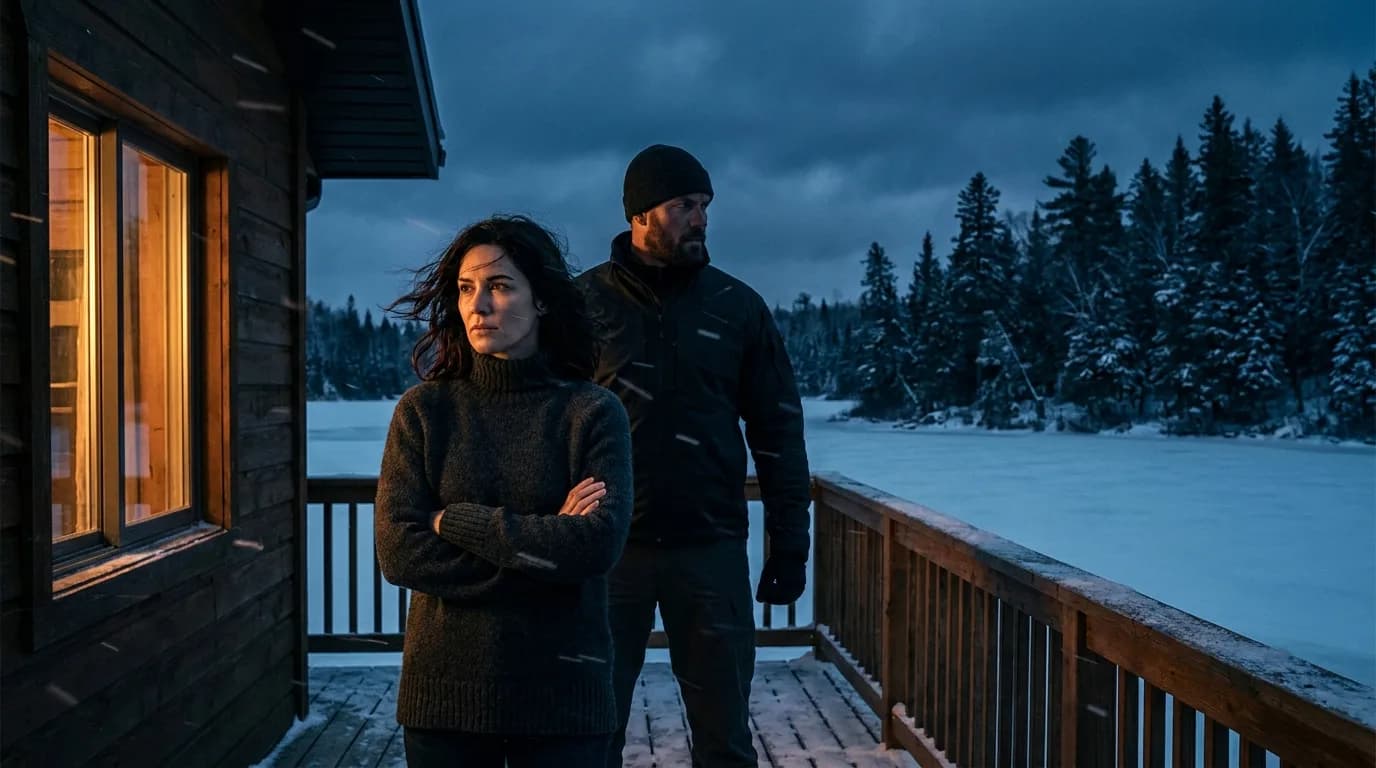
The marshals had my life in nineteen boxes, and I counted every one, because counting is what I do instead of screaming. Nineteen boxes. Thirty-four years.
It didn't reconcile.
A woman in a windbreaker was pulling my books down in armfuls without checking the spines — two years of case research and a shelf of paperbacks, all the same weight to her. Somebody else had my kitchen in a duffel bag. In the hall, a man was changing my locks, which struck me as optimistic, since I was never coming back.
“Ms. Vale.” Deputy Marshal Ruiz had said my name three times. I'd been ignoring two of them.
“I'm listening.”
“You're not.”
“I'm doing both,” I said. “It's a skill.”
Three hours earlier I had put a hard drive and eleven hundred pages into Iris Pell's hands in a federal basement and signed a chain-of-custody form.
Two years of work. Four charitable foundations. Six hundred and forty million dollars that walked into a children's cancer trust and came out the other side laundered and smiling. I kept no copies. That was the deal.
My whole life's work, and I handed it across a table and got a receipt.
The Rookwood Trust owns nine hospitals, two universities and a wing of the museum where they hold the fundraiser. Victor Rookwood is photographed at that fundraiser every October holding a very small check for a very large camera.
The interesting money never moved through the Trust. It moved through the charities the Trust rescued, and rescue is a beautiful word for what happens to a foundation when somebody needs a clean pipe.
Pell asked me, in the elevator, whether I was frightened. I told her fear was just an unrecorded liability. She didn't laugh. Nobody ever laughs.
Sunny called twice while they were boxing the kitchen. Ruiz had already sealed my phone in a bag with a barcode on it. Watching your best friend's name light up inside an evidence bag is its own particular kind of morning.
Ruiz went back to his clipboard. “Trial's in ninety days. Give or take.”
“Eighty-nine.”
He looked at me. “Give or take,” I agreed.
He let it sit a moment, then said it anyway. “You understand your position.”
I understood it precisely. There was no case without me. Documents don't testify. Somebody has to stand up and explain what they mean, and I was the only living person who could. Sole witness sounds like a protected status. It isn't. It's a single point of failure.
Ruiz tried once more, carefully — the way you slide a chair toward somebody who might be about to go down. “There's still a version where you don't do this. Pell would deal it out. Reduced case. You'd go somewhere warm and nobody would ever look for you.”
I gave it exactly the consideration it deserved. “No.”
“Ms. Vale—”
“I spent two years finding six hundred and forty million dollars,” I said. “I'm not leaving it on the table because the room got loud.”
One of them came out of my bedroom holding a shoebox. “Personal effects or storage?” Inside it was a stack of denial letters and a hospital wristband gone soft at the edges.
Rosalind Vale. Bed 12.
She spent nineteen weeks on a waiting list at a cardiac clinic on Ferrell Street. The clinic had a program until the Ansel Group Foundation restructured its giving.
Restructured is the word they used in the annual report — page eleven, under Community Impact. I have read that sentence forty times and it still costs exactly the same. Ansel was a Rookwood foundation. Everything is a Rookwood foundation, once you know where to stand.
She died on a Tuesday, in a corridor, on a gurney, four doors from a room she was approved for on the Thursday. I was in Cleveland that week, auditing vendor contracts for a hospital group. I found four hundred thousand dollars of fraud by Friday.
I was very good at my job.
“Personal effects,” I said.
Here's the thing nobody tells you about being unremarkable: it's an occupational advantage. I have spent my whole life being the person nobody remembers was in the room. You would be amazed what men leave face-up on a desk in front of someone they've already forgotten.
That is how I built the file. Not bravery. Bookkeeping.
The new door opened, and nobody had knocked. That was the first thing. Four federal marshals in my apartment, and a man walked in, and not one of them moved a hand.
He was tall and he came through the doorway like the room was billing him by the second — dark coat, no logo, nothing on him anywhere with a name on it.
He didn't look at me first. He looked at the windows. Then the roofline of the building across the street. Then the corridor behind him. Then me, and I got about a second and a half of it.
It was the most anyone had looked at me in years.
Ruiz cleared his throat, which I would later understand was the most honest review anyone gave me all day. “This is Doyle. Contract detail. He's got you through trial.”
“Contract,” I said.
“The service outsources principal protection when the threat profile exceeds—”
“I know what it means. I've audited your vendors from the other side.”
Ruiz had the decency to stop talking. Doyle didn't appear to have noticed either of us; he had crossed to my window and put the blind down without asking. He still hadn't looked at me. “You've been standing in front of that for six minutes.”
“It's my window.”
“It's a frame,” he said. “You're the picture.”
I decided then to dislike him with real commitment. He went through my apartment the way I go through a ledger — fast, in order, stopping only at the exceptions.
He moved a chair out of the entry line. He turned my mail face-down so the address didn't show. He tapped the smoke detector twice, said six words to Ruiz, and Ruiz went a shade of grey I'd never seen on a federal employee.
His coat was three years old. His boots were newer than the coat. Which meant he replaced what he used, and kept what he didn't.
That is the entire trick of my profession, by the way. You don't catch people lying. You catch the one item in a hundred that was replaced more recently than it should have been, and then you ask it a question. I was already asking him one, and I hadn't noticed yet.
He was reading the sightline out of my bedroom door when he asked it. “Who knows the file exists?”
“The prosecution team. My paralegal. That's all.”
“How many is the team?”
“Nine.”
“So eleven people know,” he said. “And one of them talks.”
“You don't know that.”
“Someone always talks. It isn't a moral position. It's arithmetic.” I hated how much I agreed with him.
He stopped in the middle of my emptied living room and looked at me properly, and I understood that everything before it had been him looking at the room I happened to be standing in. “Five rules,” he said.
“Do I get them in writing?”
“No.”
“Rule one. You go where I put you and you stay where I put you. You don't pick the door. I pick the door.”
“Rule two. You don't tell anyone where you are. Not your lawyer. Not your best friend. Not your mother.”
“My mother's dead,” I said.
“Then that one's easy.” It was the least sympathy anybody had shown me in three years — and the first thing all morning that didn't make me want to put my hand through a wall.
“Rule three. If I say down, you're on the floor before you've finished being insulted.”
“Rule four. Nothing of yours comes with you. Phone, laptop, keys, photographs. It all stays in this room.”
He delivered them the way an auditor reads out findings — no emphasis anywhere, because emphasis implies some of it is optional.
“And rule five?” He paused. Not for effect — the way a man pauses before he signs something.
“Rule five. If I tell you to leave me, you leave me. You don't come back. You don't check.”
“That's a strange rule for a bodyguard.”
“It's the only one that's ever mattered.”
I picked up the shoebox — phone, laptop, keys, photographs, all of it staying, and me walking out with a dead woman's wristband in a box under my arm in direct violation of a rule that was ninety seconds old.
He watched me do it. He said nothing. I filed that as the first exception in his ledger, and I have thought about it every day since.
So I asked him the only question in the room worth auditing. “How many people have you kept alive for ninety days?”
He lifted my coat off the back of the chair and held it out to me. “None,” he said. “Nobody's ever needed it that long.”
Here is the question I should have asked him. Not how many he'd kept alive.
How many he hadn't.
At the door he stopped. “One more thing. Wherever I put you tonight — take the side of the bed away from the window.”
“I don't have a side. I live alone.” He was already moving into the corridor, checking the stairwell, counting something under his breath.
“You sleep on the left,” he said. “Facing the door.”
He was right.
Nobody had ever asked me. Nobody had ever been there to know.
And it wasn't in any file.