
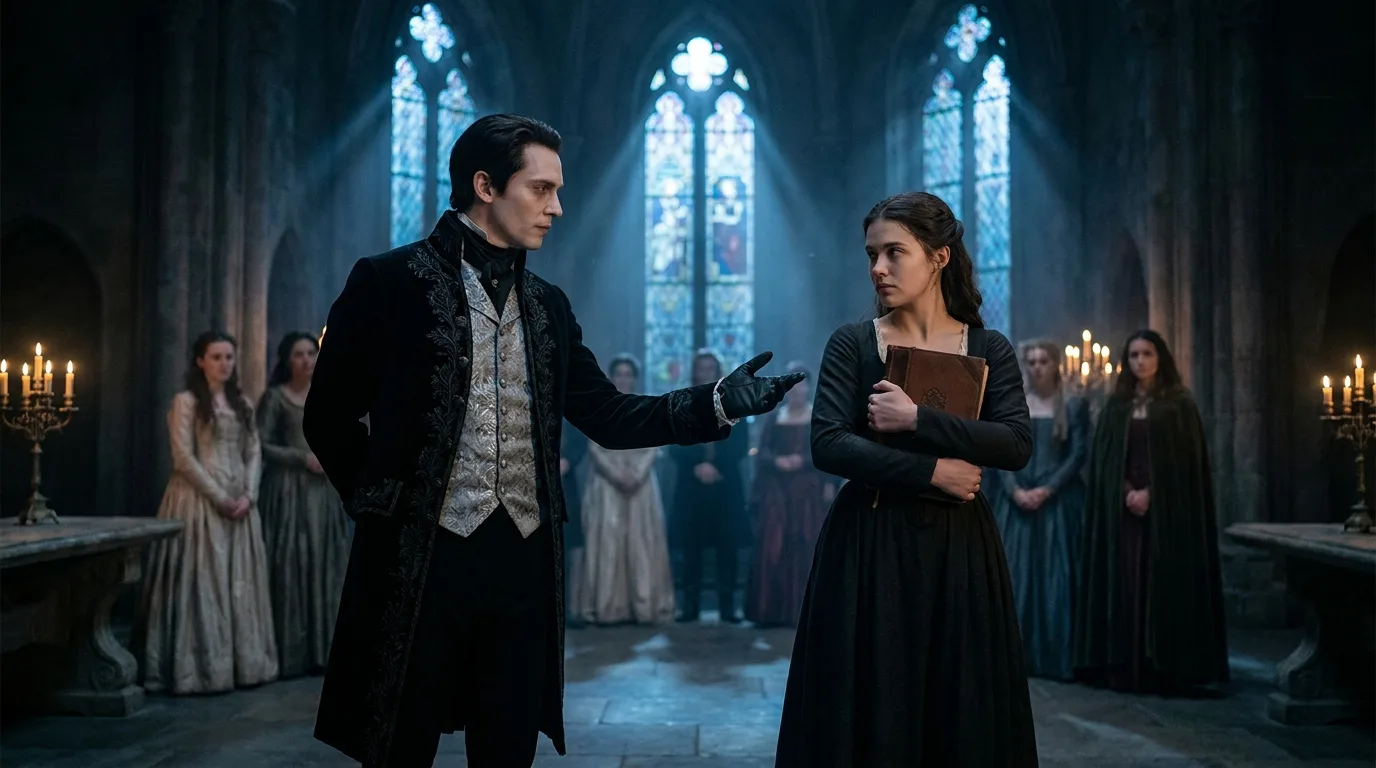
The trick to surviving a Tithe ceremony is to treat it like inventory.
Candidate forty-six: Della Voss, twenty-three, florist. Gown, borrowed. Smile, rehearsed. Hands, shaking exactly the regulation amount.
I stamp her card and slide it back under the brass grille. “Next.”
The Basilica of the Accords smells of candle smoke and cold marble, with an under-note of terror that nobody files. I file everything else. That’s the job.
Every ten years, Eversgate pays its rent.
The vampire Court keeps our walls standing, our plagues out, and the wilder courts off our throats. In exchange, once a decade, the Tithe.
Thirty tribute brides, groomed, gowned, and presented like fruit at a shrine.
Officially, they’re candidates for the honor of the Court.
Unofficially, my ledger has a column for next of kin.
“Next,” I call.
Candidate forty-seven steps up to my booth, and my stomach drops straight through the marble.
Nell.
My foster sister stands there in registry white, shaking so hard her card chatters against the grille.
“Name,” I say. The compulsion officer is three feet to my left, and protocol is the only wall I have, so I stand behind it.
“You know my name,” she whispers.
“For the record.”
“Nell Fane. Twenty-two. Laundress.” Her chin comes up while her hands give her away. That chin got us through four foster homes and one very bad winter.
I stamp her card more slowly than I have ever stamped anything in my life.
“Breathe on four,” I murmur. Marta’s rule, from the year we shared one bed, one blanket, and nothing else. “In on four. Out on four.”
Nell’s mouth wobbles toward a smile. “You’re not supposed to talk to us.”
“I’m not supposed to do a lot of things. Somehow they keep happening.”
Officer Brandt leans over my partition, all polished buttons and borrowed menace. “Problem, clerk?”
“No, officer. Verifying the candidate.”
“That’s my job.” He turns to Nell, and his voice drops into the oiled register they teach at the academy. “Speak true. Are you Nell Fane, entered under your own name?”
The push rolls off him in a slow, syrupy wave. I watch it land on her — pupils flaring, spine straightening, the truth opening her mouth whether she wants it there or not.
“Yes,” she says, flat as glass.
The wave reaches me too. It always does.
It breaks and runs off me like rain on a window.
Nothing. It does nothing.
Brandt smirks at me over her head. “Want me to verify your clerk’s oath while I’m warmed up, Hallow? Oh. Right. Waste of breath.”
“Regularly,” I agree, and wave Nell on before my face can do anything stupid.
Here’s the thing about being a null. It sounds like a superpower and it lives like a criminal record.
Compulsion doesn’t work on me. Not a push, not a suggestion, not the truth-binding that every contract in this city runs on.
No landlord can bind my lease. No bank can bind my word. No respectable family wants a girl whose promises can’t be proven.
Unverifiable, the registry says. Like I’m a rumor with shoes.
So I catalogue Tithe records for the Concord Office, because dead files don’t care whose word I give.
Paper never asks me to prove myself. Paper just takes — it always gets the first taste of me. Ask my papercuts.
“Next.”
Candidate forty-eight cries the whole way through. Candidate forty-nine flirts with Brandt, which is like flirting with a filing cabinet, only less warm.
Candidate fifty-three faints. I note the time.
“Do I curtsy to the Elders or to the floor?” candidate fifty-six asks me, white to the lips.
“The floor’s more forgiving,” I tell her. “Aim there.”
I am on candidate fifty-nine, a butcher’s daughter with brave eyes, when every bell in the basilica begins to toll at once.
The whole hall stops pretending it isn’t afraid.
The great doors open on the Court of Eversgate. Elder Thane comes first, with his black staff and a face like a closed courthouse. Elder Isolde follows in grey silk the color of drowned things.
Behind them, a dozen lords with faces like beautiful coins, minted centuries apart and never spent.
And Lord Casimir, of course, who has presided over every Tithe for a hundred years. Silk voice. Winter smile. The kind of beauty that makes you count your fingers after he shakes your hand.
Except Casimir stops walking.
Except the herald isn’t announcing him.
“His Majesty Lucien Draven,” the herald cries, his voice cracking clean down the middle, “King of Eversgate, Keeper of the Accords, Lord of the Long Night.”
The King does not attend Tithes.
The King has not attended anything in a hundred years. He is a signature on proclamations. A profile on the coin. A light in the Citadel’s highest window that never, ever moves.
The hall kneels. All of it, velvet and marble and bone, down in one breath, like a field under wind.
Even the candle flames lean.
Clerks bow at their desks; it’s in the manual. I bow my head with the rest and watch through my lashes, because watching is the one thing nobody has ever managed to take off me.
He isn’t what I expected.
I expected a monument. What comes up the nave instead is quieter and worse — dark-haired, unhurried, four hundred years wearing a man like a very good coat. He looks like the pause before a verdict.
The room is so silent I can hear candle wax drip.
“Majesty.” Casimir recovers first, smooth as poured cream. “You honor us. Had we known—”
“You would have arranged things.” The King’s voice isn’t loud. It reaches the last row anyway. “I know. Proceed.”
Two rows from the dais, an Elder’s knuckles have gone white around a black staff.
Interesting. I file that too.
The Presenter begins the litany, and the candidates rise in one long white row. Thirty girls. Sixty shaking hands.
The King of Eversgate walks the line the way a man reads spines in a library he already owns.
He passes the first candidate without turning his head.
The second. The fifth. The ninth.
A murmur starts up in the galleries and dies of fright.
Each girl he passes seems to fold a little, relief and insult in the same breath. Ten years of grooming, and his eyes never snag once.
He reaches Nell.
Pass her, I think, with everything I have, every cell lined up and screaming in one direction for once in my life. Pass her. Pass her.
He passes her.
I start breathing again. On four, like we were taught.
Candidate sixty is a shipwright’s daughter wearing a crown of paper roses. He passes her too, and now there is nothing left to pass.
The Presenter runs out of litany mid-word.
The King keeps walking.
Thirty brides stand behind him like a sentence he declined to finish. Ahead of him there is only the rail — the rail that separates the ceremony from the clerks’ stalls, the rail that exists so people like them never have to look at people like us.
He crosses it without slowing down.
The basilica forgets how lungs work.
There is nothing on this side of the hall but ledgers, ink, and me.
I do what I always do when the world tilts. I pick up my pen.
Candidate sixty: passed over, I write, very neatly.
The light across my desk goes dark.
Winter and myrrh. That’s what reaches me first, over the smoke and the old paper — cold as a sealed chapel, sweet as embalmed roses. A scent like a locked door.
I look up.
Nobody looks at me. That’s the first thing you learn, being what I am. Eyes slide off the unverifiable girl the way compulsion does.
The King of Eversgate is looking at me the way you look at a word you’ve spent four hundred years trying to remember.
“Candidates are to your left, Majesty,” I say.
Somewhere behind him, the Presenter makes a sound like a stepped-on flute.
He doesn’t smile. Something happens at the edge of his mouth that might once, centuries ago, have been related to one.
Up close his eyes aren’t black. They’re the grey of dawn through smoke, and they don’t slide off me at all.
He looks at my ink-stained fingers. The stamp. The ledger. The scar on my thumb where paper has been tasting me for years.
It takes three seconds and feels like an audit of my entire life.
Then he turns — to the Council, to the Presenter, to thirty brides in white and a thousand kneeling witnesses — without ever quite taking his eyes off mine, which shouldn’t be possible, and isn’t, for anyone else.
“Her.”