
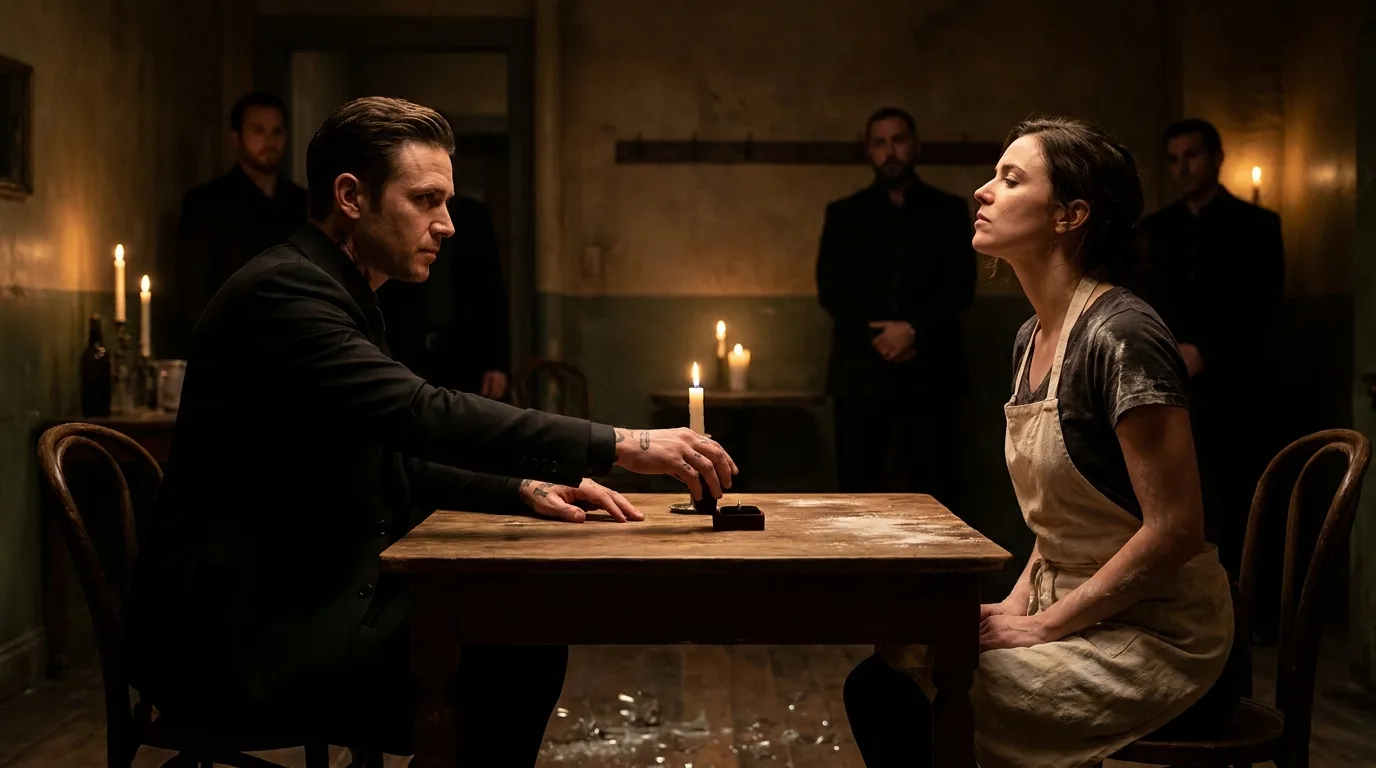
For her nineteenth birthday, my sister got a honey cake, a secondhand scarf, and the Russian mafia.
The cake was mine — day-old sponge, honey from the emergency jar, and enough frosting to hide both facts.
The scarf was from Papa.
The mafia was also, technically, from Papa.
But I’m getting ahead of myself.
Tuesday night, nine o’clock, Zlatá Praha — our family restaurant on Brighton Beach Avenue. Four tables occupied, two of them by Papa’s chess friends, who only ever ordered tea.
“Blow them out before the wax hits the frosting,” I said. “We can’t afford new frosting.”
Katya laughed and leaned over the candles. Nineteen little flames, and her whole face gold.
“Wish for a rich husband,” called old Mr. Horáček from table six.
“Wish for a dishwasher,” I said. “The machine. The human one quit.”
Katya closed her eyes like she was actually deciding. My little sister still believed in wishes, which meant I’d done at least one thing right since Mama died.
She blew. All six customers clapped. Katya lifted her phone to film the cake from three angles for her followers, because Katya documents everything, always, the way other people breathe.
For one entire minute, we were rich.
Then the front window came in.
Glass everywhere — across the tables, into the frosting, a glittering rain that turned the whole room silent.
Katya screamed.
Papa didn’t.
That’s the detail I keep going back to. My father sat there with his tea and didn’t even look surprised.
Three men came through the door in good coats and cheap intentions. The first one flipped table two like it had insulted his mother.
“Petr Novak!” he sang. Rings on every finger, gold tooth to match. “You’ve been hiding from us, Petr.”
The second one turned our deadbolt behind them. The third stayed at the door, watching the street.
Here’s a thing about our avenue: everybody pays somebody. The bakery pays. The banya pays. In fifteen years, nobody had ever asked us for a dime.
Papa called it luck.
Luck, in my experience, keeps books.
“We’re closed,” I said, stepping out from behind the counter.
The one with the rings smiled at me the way men smile at small dogs. “She’s funny.”
“I’m hilarious. You broke my window, so tonight the comedy’s free. Get out.”
“Petr owes money,” he said, done with me already. “Petr owes the Volkovs a great deal of money, and Petr stopped answering his phone.”
The name moved through the room like cold water. Even the chess players flinched. Everyone on Brighton Beach knows the name Volkov.
“Papa?” Katya’s voice, gone small.
My father folded his hands and studied the tablecloth, and everything in my chest went down like a dropped tray.
“Whatever he owes, we’ll pay,” I said. “There are payment plans. Civilized instruments. I keep the books — talk to me.”
“With what?” Rings looked around at the flaked paint, the taped booth, the cake full of glass. “The décor?”
He wasn’t wrong, which is why I hated him.
The second man hauled my father up out of his chair by the collar. Papa hung there, limp as laundry, apologizing to nobody in particular.
“Stop it—” Katya lunged. I caught her wrist.
Rings looked at my sister a beat too long. “Or maybe,” he said, “there’s another way Petr pays.”
He reached for her.
People ask when I decided I’d do anything for Katya. There was no when. It came factory-installed.
The knife was in my hand before the thought finished.
Not a restaurant knife. It lived in my knife roll between the paring and the boning blades — black handle, a wolf’s head worked into the steel.
Eight years ago, somebody left it in our cellar.
That’s a different story. I didn’t know yet that it was the same story.
I put the point under Rings’s chin, and the room stopped.
“Touch her,” I said, “and you’ll leave a deposit.”
Silence has textures. This one had teeth.
“Mila,” Papa whispered. “Miláčku. Put it down.”
“Papa, be quiet. The adults are talking.”
Rings looked down his nose at the blade. Then something happened in his face — he went pale in stages, like a sunset in reverse.
He wasn’t looking at the edge.
He was looking at the wolf.
“Where did you get that?” he asked. The sing-song was gone.
“None of your business.”
By the door, the third man said one word in Russian, soft, like a prayer going the wrong direction.
I grew up on this avenue. My Russian is kitchen-grade but functional.
The word was pakhan.
The bell over our door chimed, polite as Sunday.
Cold came in first. Then the man.
Dark coat. No gun in sight. Mid-thirties, unhurried — he walked into our wrecked dining room like he had a reservation.
I want to say he was handsome, and he was, but that’s like saying winter is cool. The temperature was the least of it.
The room reorganized itself around him. The man holding my father let go so fast Papa hit the chair.
“Boss,” Rings said. He had a new voice for this one. Smaller.
The man didn’t look at Rings. Didn’t look at Papa, or the broken window, or the glass bleeding into the honey cake.
He looked at me.
And here’s the thing I couldn’t explain that night, the thing that itched behind my ribs for weeks after: he looked at me like a man checking on a wound he already knew was there.
Like he knew me.
I’d never seen him before in my life. I would have remembered. You remember weather like that.
“You broke her window,” he said. To the room, mild as milk, and every man in it flinched.
“The old man wouldn’t answer his—”
“I heard you from the street. Half the borough heard you.”
He righted the flipped table one-handed and set it down without a sound, which was somehow worse than the flipping.
Then he said something quiet in Russian, and the three of them went out through the glass they’d made, careful as altar boys.
Which left the four of us, a ruined cake, and my knife. Still out.
I didn’t put it away. Pride is also factory-installed.
His eyes dropped to the blade, and there — quick, gone — something crossed his face. If it had stayed longer, I’d have called it grief.
“You have a name?” I said. “Or do I just call you the weather?”
“Nikolai Volkov.”
Volkov. The name our whole avenue paid.
Except us.
“Then take your boys, Mr. Volkov, and send me an invoice for my window.” My voice held. My knees were freelancing.
He pulled out a chair at the birthday table and sat, uninvited, like an honored guest. He looked at the glass-studded cake. At my sister’s tear-streaked face. Back at me.
“Happy birthday,” he told Katya, and it was gentle, and the gentleness was the most frightening thing that had happened all night.
“Nineteen,” Katya whispered, for no reason at all.
“Sit, Miss Novak,” he said to me. “Your father borrowed from my family’s bank. The kind without deposit insurance.”
I stayed standing. Standing was all I had left.
Papa finally found his voice, and it came out in pieces. “Nikolai Maximovich… how much? Tell me how much.”
Volkov let the question hang while the radiator ticked and my sister’s birthday candles smoked in the ruined frosting.
“The debt is two million.” His eyes never left me. “Or her.”